
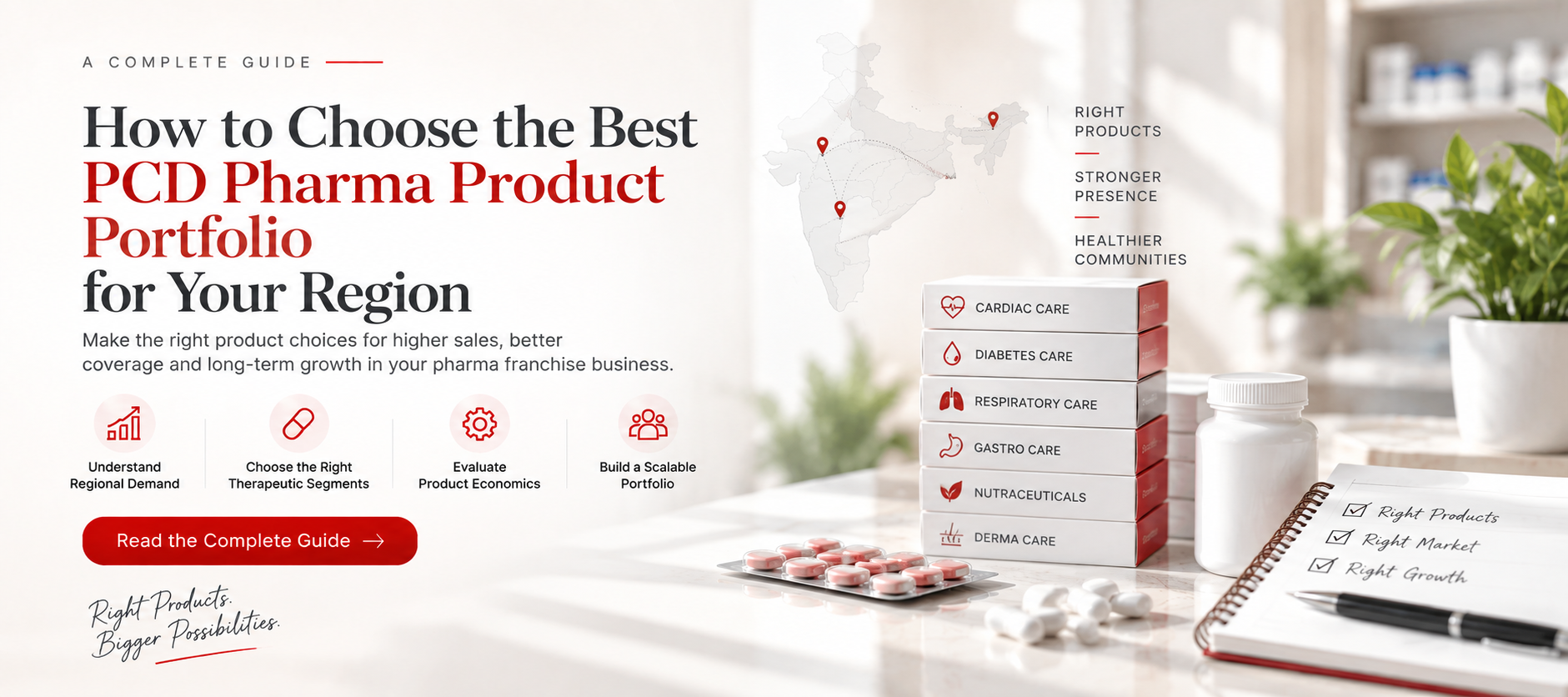
Choosing the right PCD pharma product portfolio is one of the most important decisions for a new pharmaceutical franchise partner. The success of your business does not depend only on how many products you offer. It depends on whether your selected products match the doctors, patients, pharmacies, hospitals and disease patterns in your territory.
A large catalogue may look impressive, but an oversized first order can lock money in slow-moving stock. A focused, demand-driven portfolio is usually more practical for building repeat sales, maintaining cash flow and reducing expiry risk.
1. Why Product Portfolio Selection Matters in a PCD Pharma Franchise
In the PCD pharma business, your product portfolio determines what you can promote to doctors, supply to retailers and reorder from the company. A mismatch between your products and your local market can result in low sales, blocked capital and stock nearing expiry.
The right portfolio should help you create a stable base of fast-moving products while also allowing room for better-value specialty and chronic-care therapies.
| Portfolio Approach | Likely Outcome | Business Impact |
|---|---|---|
| Large catalogue without demand research | Slow-moving stock, scattered promotion and poor reorder planning. | High inventory holding and greater expiry risk. |
| Focused portfolio based on local demand | Clear doctor coverage and stronger repeat-order opportunities. | Better stock rotation and working-capital efficiency. |
| Only high-margin products | Products may have limited local demand or high competition. | Paper margins may not translate into sales. |
| Balanced acute, chronic and specialty mix | More stable monthly billing across different customer needs. | Improved long-term contribution potential. |
2. Start with Local Market Research Before Choosing Products
Every district, city and town has a different healthcare ecosystem. Before placing a first order, spend time understanding the people who will influence demand in your market: doctors, chemists, hospitals, nursing homes, clinics and patients.
Study doctor concentration in your territory
Identify the number of doctors and clinics in your target area. A district with many general physicians may require stronger acute-care coverage, while a city with many specialists may support dermatology, gynecology, pediatric, cardiac or neuro-psychiatric products.
Talk to pharmacies and stockists
Retail chemists can provide useful information about commonly prescribed molecules, price-sensitive categories, fast-moving brands and frequently unavailable products. Their feedback should be considered alongside doctor prescription potential.
Observe local disease patterns
Seasonal and regional health trends matter. Respiratory infections, gastrointestinal issues, dermatology conditions, diabetes, hypertension, women’s health and nutritional deficiencies may vary by geography, climate and population profile.
Urban territories may support specialty therapies, chronic-care products, branded nutraceuticals and premium prescription segments due to higher specialist availability.
Semi-urban areas often need a balanced portfolio of acute medicines, general physician products, pediatric products and selected chronic therapies.
Rural markets may be more price-sensitive and can require practical, affordable formulations with strong general practitioner and retail acceptance.
Territories around hospitals and nursing homes may offer demand for injectables, antibiotics, critical-care support products and specialty segments where permitted.
3. Map Doctor Specialties to Relevant Pharma Product Categories
A successful PCD pharma product portfolio should reflect the doctor specialties available in your region. You do not need every therapeutic category from the beginning. You need the categories that fit the prescriber base you can realistically cover.
| Doctor Specialty / Prescriber Type | Relevant Product Categories | Portfolio Consideration |
|---|---|---|
| General Physicians | Anti-infectives, analgesics, gastro, respiratory, anti-allergic, vitamins and minerals. | High repeat potential when supported by doctor coverage and retailer availability. |
| Pediatricians | Pediatric syrups, drops, suspensions, probiotics, nutrition and immunity support. | Flavor, dosage convenience and seasonal demand are important. |
| Gynecologists | Iron and folic acid, calcium, multivitamins, antifungal, hormonal-support and women’s wellness products. | Prescription trust and regular doctor visits can improve repeat sales. |
| Dermatologists | Anti-fungal creams, acne care, moisturizers, sunscreen, pigmentation and hair-care products. | Brand positioning, packaging and patient affordability are important. |
| Physicians / Diabetologists | Anti-diabetic, cardiac, gastro, liver-support and nutritional products. | Chronic therapy can provide recurring demand when compliance is high. |
| Orthopedics | Calcium, vitamin D3, pain management, muscle relaxants and joint-support nutraceuticals. | Often combines prescription products with long-term supplement demand. |
Before finalizing your product list, identify which doctors you can meet consistently. A portfolio should support your actual field strategy—not an ideal market that you cannot reach.
4. Build a Balanced Portfolio: Acute, Chronic and Specialty Products
For a new PCD pharma franchise, a balanced portfolio reduces dependence on one product category. Acute products can generate regular movement, while chronic and specialty products may create better continuity and doctor loyalty.
Acute-care products
Acute therapies are commonly prescribed for short-term illnesses such as fever, cough, cold, infection, pain, acidity and digestive discomfort. These products can support faster stock movement when the demand is genuine.
Chronic-care products
Chronic therapies are used for long-duration conditions such as diabetes, hypertension, cardiovascular disease, thyroid conditions and neurological disorders. These categories may generate repeat demand, although competition and doctor acceptance can be stronger.
Specialty products
Specialty ranges such as dermatology, gynecology, pediatrics, ophthalmology, orthopedics and neuro-psychiatry should be added when your local doctor base and field coverage justify them.
5. Key Factors to Check Before Adding Any Product
Before including a product in your PCD pharma franchise order, review it from both a sales and inventory perspective. The following factors can help you choose more effectively:
6. Essential Product Categories for a Starter PCD Pharma Portfolio
The exact product list should always be based on your region. However, many new franchise partners begin by evaluating a practical set of high-demand categories.
| Product Category | Examples of Common Needs | Why It May Be Useful |
|---|---|---|
| Anti-Infective Range | Antibiotics, anti-bacterial combinations and related support products. | Commonly considered for general physician and infection-related prescriptions. |
| Gastro Range | Acidity, reflux, digestion, liver support and probiotics. | Often has regular outpatient demand across general practice. |
| Pain Management | Analgesics, anti-inflammatory medicines, muscle relaxants and topical gels. | Relevant to general practice, orthopedics and injury-related treatment. |
| Respiratory & Anti-Allergic | Cough syrups, anti-allergic tablets, inhalation support and expectorants. | Can show seasonal demand in many regions. |
| Nutraceuticals | Multivitamins, calcium, iron, vitamin D3, protein and immunity support. | Can complement chronic care, gynecology, pediatrics and orthopedics. |
| Dermatology Range | Anti-fungal creams, acne care, moisturizers, sunscreen and lotions. | Useful where dermatologists and skin clinics are accessible. |
| Cardiac & Diabetic Care | Products related to hypertension, cholesterol, blood sugar and heart health. | May support recurring demand in chronic-care territories. |
For product-specific information, always request an updated PCD pharma product catalogue, price list, composition list and availability status from the company.
7. Check Competitor Products Before Finalising Your Order
Competition is not always a reason to avoid a product. A product with many competing brands may also indicate strong doctor demand. The key is to understand whether your brand can be positioned competitively.
Questions to ask during competitor analysis
- Which brands are doctors already prescribing for the same molecule?
- What is the approximate MRP range in the local market?
- What retailer margin or schemes are competitors offering?
- Are competitors able to maintain regular stock availability?
- Can your product offer a differentiated composition, dosage form, packaging or price point?
- Will your company provide visual aids, samples or promotional support for doctor coverage?
8. Balance Product Margin with Stock Movement and Inventory Risk
One of the biggest mistakes in the PCD pharma business is selecting products only because their margin looks attractive. The effective profitability of a product depends on how quickly it moves and whether it can be reordered before expiry.
For example, a product with a 60% paper margin but very low demand may remain in stock for months. A product with a 35% to 40% gross margin but regular monthly movement may provide stronger overall contribution.
For a better understanding of actual contribution after operating costs, read our guide on average profit margins in a PCD pharma franchise.
9. How to Plan Your First PCD Pharma Product Order
Your first order should be strategic, not emotional. Avoid purchasing every available product simply to create a large catalogue. Instead, build a launch order around products you can actively promote and sell within the first few months.
List the doctors, clinics, hospitals and pharmacies you plan to cover in your first 60 to 90 days.
Begin with therapeutic categories that match the doctor specialties and local demand in your area.
Include practical general products that can help retailers and doctors place repeat orders.
Order lower quantities for new, untested products and higher quantities only for validated fast movers.
New partners should also plan the first order around their available working capital. Do not use all your funds for opening stock. Keep capital for market visits, promotional materials, freight, license compliance, retailer credit and reorders.
10. Common Mistakes While Selecting a PCD Pharma Product Portfolio
Ordering a large catalogue without demand validation can create slow-moving stock and cash-flow pressure. Start focused and expand based on actual sales data.
Premium-priced products may not work in every territory. Compare pricing with the local market and patient affordability before selecting a product.
High margins are useful only when products move. Focus on a healthy combination of margin, demand, prescription potential and stock rotation.
Adding dermatology, gynecology or cardiac products without access to relevant doctors can result in poor returns on inventory and promotion.
Every product should have a clear expected sales cycle. Avoid large quantities of products with uncertain movement or shorter shelf life.
11. PCD Pharma Product Portfolio Checklist Before You Invest
Before finalising your product portfolio with a PCD pharma company, ask for the following information:
Choose the Right PCD Pharma Portfolio for Your District
Connect with Mensa Medicare to request the current product catalogue, composition list, price details and monopoly availability for your target territory.
PCD Pharma Product Portfolio FAQs
The best PCD pharma products depend on local doctor prescriptions, disease patterns, patient affordability and retailer demand. A balanced portfolio generally includes fast-moving acute products, selected chronic therapies, nutraceuticals and specialty products relevant to the territory.
There is no fixed number. New franchise partners should begin with a focused portfolio of high-demand products rather than purchasing a very large catalogue. The opening order should be based on doctor coverage, expected monthly demand, available capital and storage capacity.
Study nearby clinics, doctor specialties, hospital departments, pharmacy sales patterns, local disease seasonality, competitor portfolios and retailer feedback. Field-level market research helps identify products with better repeat-order potential.
No. High paper margins alone do not ensure profitability. Products should be evaluated on demand, prescription potential, competition, retailer acceptance, repeat order frequency, inventory movement and expiry risk.
A practical starter product mix may include common anti-infectives, pain management, gastro, respiratory, vitamins and minerals, anti-allergic products, dermatology or gynecology products where relevant, and selected chronic-care medicines based on local prescriber demand.